
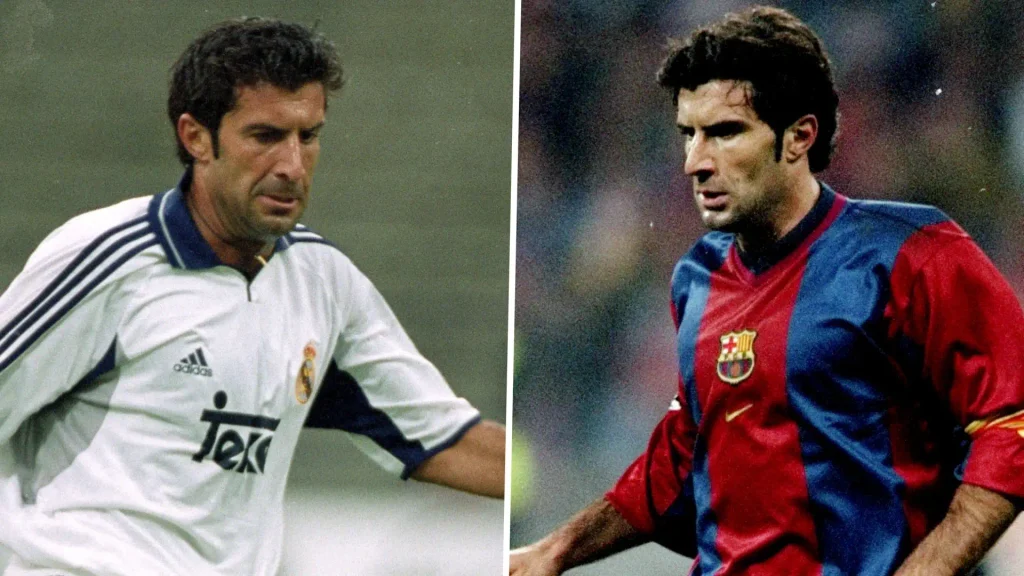
In the summer of 2000, the football world witnessed a transfer so shocking, so unprecedented, and so fiercely controversial that its shockwaves are still felt today. When Luis Figo swapped the Blaugrana of Barcelona for the pristine white of Real Madrid, it was more than just a player changing clubs—it was the declaration of a new era in sports business, the birth of the Galácticos, and the ignition of football’s most bitter modern rivalry.
If you are a football historian or a fan of the dramatic, the Figo saga is the ultimate case study in power, politics, and the art of the impossible deal.
The Context: A God in Catalonia
By the end of the 1999-2000 season, Luis Figo was arguably the best player on the planet (he would go on to win the Ballon d’Or later that year). At Barcelona, he wasn’t just a star; he was their captain, their creative heartbeat, and a beloved adopted son of Catalonia. He had even dyed his hair in Barça colors to celebrate a league title and famously mocked Real Madrid during trophy celebrations.
In the eyes of the Barcelona faithful, Figo was untouchable. In the eyes of the Madrid hierarchy, he was the ultimate prize.
Florentino Pérez’s Masterstroke
The saga began not in the boardroom, but on the election trail. Florentino Pérez was an ambitious construction magnate running for the presidency of Real Madrid against the incumbent, Lorenzo Sanz, who had just won two Champions League titles. Pérez needed a miracle to win the election. His promise: If elected, I will bring Luis Figo to the Santiago Bernabéu.
Pérez executed one of the most cunning business maneuvers in sports history:
- The Pre-Contract: Pérez approached Figo’s agent, José Veiga, offering a lucrative pre-contract. If Pérez won the election, Figo would join Madrid. If Pérez lost, Figo would keep roughly €2 million just for signing the paper.
- The Trap: Thinking Pérez had no chance of winning against a Champions League-winning president, Veiga signed. However, a penalty clause stipulated that if Pérez won and Figo backed out, the player would have to pay Real Madrid €30 million in compensation.
- The Leverage: Pérez used this agreement to publicly guarantee Figo’s arrival, promising to pay the season ticket fees for every Madrid member if he failed to deliver.
The Impossible Becomes Reality
Driven by the spectacular promise, Madrid’s members voted Pérez into power. Suddenly, Figo was trapped. He didn’t want to leave Barcelona, and incoming Barça president Joan Gaspart pleaded with him to stay.
However, Barcelona refused to pay the €30 million penalty clause to buy Figo out of his own agent’s mistake. Left with no other option, Florentino Pérez deposited Figo’s €62 million (10 billion pesetas) buyout clause at the La Liga offices. It was a world-record fee that completely bypassed Barcelona’s ability to negotiate. The deal was done.
The Aftermath and the “Pig’s Head” Clásico
The reaction in Catalonia was apocalyptic. Figo went from idol to “Judas” overnight. His restaurant in Barcelona was vandalized, and his name became a curse word at the Camp Nou.
The raw hatred culminated on November 23, 2002, during Figo’s second return to the Camp Nou. Every time he went to take a corner kick, a barrage of debris rained down from the stands: lighters, coins, whiskey bottles, and, most infamously, a severed suckling pig’s head. The match had to be suspended for 16 minutes as riot police shielded the pitch. It remains one of the most defining and visceral images in the history of El Clásico.
Legacy: The Dawn of the Galácticos
The Figo transfer did more than just break Barcelona’s hearts; it changed the financial landscape of football. It proved that no player was truly untouchable if a club was willing to trigger a buyout clause.
More importantly, it launched Florentino Pérez’s Galáctico policy. Figo was the first domino. Over the next three summers, he was followed by Zinedine Zidane, Ronaldo Nazário, and David Beckham, turning Real Madrid into the most glamorous and commercially dominant sporting institution on Earth.